

The Rise of the Fractional Model
There is a quiet revolution happening in the way businesses access senior talent. For decades, the choice was binary: hire a full-time executive or go without. If you needed a Finance Director, a Marketing Director, or a General Counsel, you either committed to a six-figure salary, employer’s National Insurance, pension contributions, and all the overhead that comes with a permanent hire—or you simply managed without, making do with junior staff, ad-hoc advice, or your own best guesses.
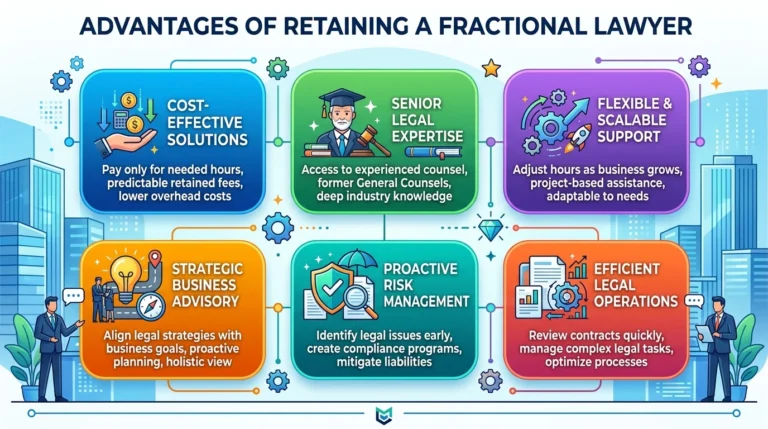
The fractional model breaks that binary. A fractional professional is a senior expert who works with your business on a part-time, flexible basis—typically a few hours a week or a few days a month. They bring the same depth of experience as a full-time hire, but you only pay for the time you actually need. It is the difference between buying a house and renting exactly the right room for exactly the right amount of time.
The fractional model breaks that binary. A fractional professional is a senior expert who works with your business on a part-time, flexible basis—typically a few hours a week or a few days a month. They bring the same depth of experience as a full-time hire, but you only pay for the time you actually need. It is the difference between buying a house and renting exactly the right room for exactly the right amount of time.
Where Did Fractional Services Come From?
The concept is not entirely new. Interim management has existed for decades, and the consulting industry has always offered senior expertise on a project basis. But fractional services are different in a meaningful way: they are not about parachuting in for a crisis or delivering a one-off strategy document. A fractional professional becomes part of your team. They attend your meetings, understand your culture, know your people, and build relationships with your clients and suppliers. They just do it for fifteen hours a month rather than forty hours a week.
The model gained serious traction in the United States, particularly in the technology sector, where fractional Chief Financial Officers and fractional Chief Marketing Officers became commonplace among venture-backed start-ups. These companies needed senior strategic guidance but could not justify or afford a full C-suite from day one. The fractional model gave them access to the experience they needed at a price point that made sense.
The model gained serious traction in the United States, particularly in the technology sector, where fractional Chief Financial Officers and fractional Chief Marketing Officers became commonplace among venture-backed start-ups. These companies needed senior strategic guidance but could not justify or afford a full C-suite from day one. The fractional model gave them access to the experience they needed at a price point that made sense.

Why the UK Market Is Ready
The UK is now experiencing its own fractional moment. Several forces are converging. Post-pandemic, businesses have become far more comfortable with remote and hybrid working arrangements, which removes the assumption that senior professionals must be physically present five days a week. The cost-of-living crisis and economic uncertainty have made businesses more cautious about adding permanent headcount. Meanwhile, a growing number of highly experienced professionals – many in their forties and fifties, with two decades of corporate or City experience – are choosing portfolio careers over traditional employment, creating a deep pool of available fractional talent.
For small and medium-sized enterprises in particular, the fractional model solves a problem that has never had a good answer: how do you access the strategic expertise that larger competitors take for granted, without the cost base that would sink your business? The answer, increasingly, is that you access it fractionally.
For small and medium-sized enterprises in particular, the fractional model solves a problem that has never had a good answer: how do you access the strategic expertise that larger competitors take for granted, without the cost base that would sink your business? The answer, increasingly, is that you access it fractionally.
How Fractional Engagements Typically Work
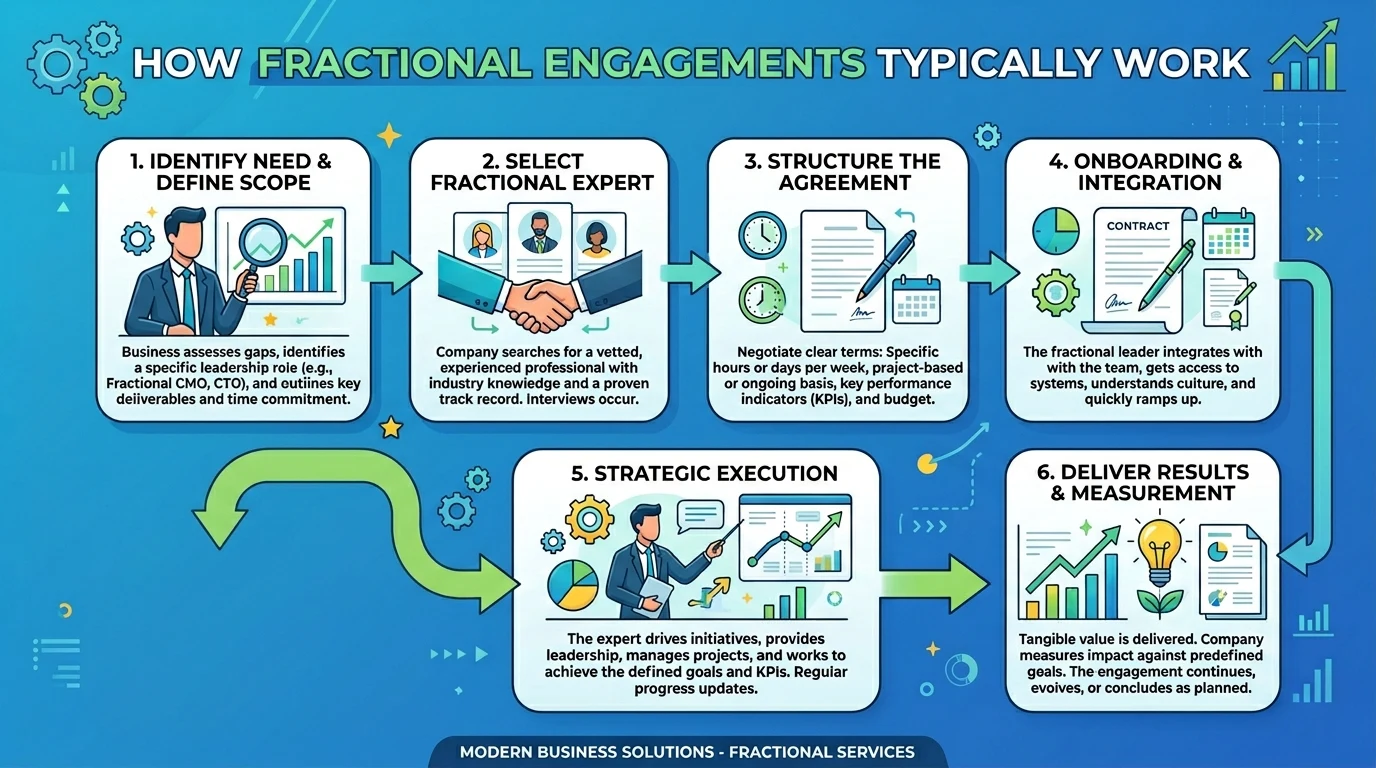
A fractional engagement usually begins with a scoping conversation to understand the business, its challenges, and the level of support required. From there, the fractional professional and the business agree on a monthly time commitment—this might be as little as five hours a month for light-touch advisory, or as much as three or four days a week for a deeply embedded role.
The work is typically delivered through a blend of scheduled calls or video meetings, asynchronous communication via email or messaging platforms, and focused deep-work sessions on specific projects or documents. Most fractional professionals work with multiple clients simultaneously, which means they bring a breadth of perspective that a single-company employee rarely develops.
The Core Benefits at a Glance
1. You get senior-level strategic thinking, not junior execution passed off as expertise.
2. You pay only for the hours you use, scaling up during busy periods and down during quieter ones.
3. You benefit from cross-pollination: your fractional professional sees patterns and solutions across multiple businesses and industries.
4. You avoid the cost and commitment of a full-time hire: no recruitment fees, no employer’s NI, no pension contributions, no long notice periods.
5. You get continuity and relationship depth that one-off consultants and advisers cannot match.
The work is typically delivered through a blend of scheduled calls or video meetings, asynchronous communication via email or messaging platforms, and focused deep-work sessions on specific projects or documents. Most fractional professionals work with multiple clients simultaneously, which means they bring a breadth of perspective that a single-company employee rarely develops.
The Core Benefits at a Glance
1. You get senior-level strategic thinking, not junior execution passed off as expertise.
2. You pay only for the hours you use, scaling up during busy periods and down during quieter ones.
3. You benefit from cross-pollination: your fractional professional sees patterns and solutions across multiple businesses and industries.
4. You avoid the cost and commitment of a full-time hire: no recruitment fees, no employer’s NI, no pension contributions, no long notice periods.
5. You get continuity and relationship depth that one-off consultants and advisers cannot match.
While fractional CFOs led the charge, the model now spans virtually every senior business function. Fractional Chief Marketing Officers help SMEs build brand strategy without the cost of a full-time marketing leader. Fractional Chief Technology Officers guide product development for businesses that need technical leadership but not a permanent CTO. Fractional HR Directors build people strategies for companies scaling from twenty to two hundred employees.
Two applications stand out as particularly transformative for small and medium-sized businesses: fractional finance leadership and fractional legal services. Both are areas where the cost of getting it wrong is high, where senior expertise genuinely matters, and where the traditional full-time hiring model has priced most SMEs out of the market altogether. The fractional approach changes that equation entirely.
Fractional CFO Services: Finance Leadership Without the Full-Time Price Tag
Of all the fractional disciplines, the fractional CFO is the most mature and the most widely adopted. There is a reason for that. Finance sits at the centre of every commercial decision a business makes, and the gap between a competent bookkeeper and a genuinely strategic finance leader is enormous. Most growing businesses feel that gap long before they can afford to close it with a full-time CFO.
A fractional CFO fills that gap. They bring the same strategic financial thinking you would expect from a senior City or industry veteran, but they deliver it on a part-time basis that matches your actual business needs.
A fractional CFO fills that gap. They bring the same strategic financial thinking you would expect from a senior City or industry veteran, but they deliver it on a part-time basis that matches your actual business needs.
What a Fractional CFO Actually Does
GreenShift – Page-Building Gutenberg Blocks
It helps to be specific about what CFO services look like in practice, because the term gets used loosely. A fractional CFO is not a bookkeeper, not an accountant filing your year-end returns, and not a controller producing monthly management accounts (although they will almost certainly work closely with all three). A fractional CFO operates a level above that work, focusing on financial strategy, commercial decision-making, and the long-term financial health of the business.
In a typical month, a fractional CFO might build a three-year financial model, pressure-test the assumptions behind a pricing change, design a cash flow forecasting system, negotiate with a lender, prepare investor-facing materials for a funding round, review the monthly management accounts and translate them into commercial insight, and sit in on the leadership team meeting to bring a finance perspective to non-finance decisions.
The point is that a fractional CFO can help you see the financial consequences of your choices before you make them, rather than after.
In a typical month, a fractional CFO might build a three-year financial model, pressure-test the assumptions behind a pricing change, design a cash flow forecasting system, negotiate with a lender, prepare investor-facing materials for a funding round, review the monthly management accounts and translate them into commercial insight, and sit in on the leadership team meeting to bring a finance perspective to non-finance decisions.
The point is that a fractional CFO can help you see the financial consequences of your choices before you make them, rather than after.
When to Hire a Fractional CFO
GreenShift – Page-Building Gutenberg Blocks
The most common triggers for businesses to hire a fractional CFO are predictable. The founder or managing director finds themselves spending more time on spreadsheets than on running the business. Cash flow has become unpredictable and stressful. A funding round is on the horizon and the numbers need to stand up to investor scrutiny. The business is scaling rapidly and the existing finance function—often a bookkeeper and an external accountant—cannot keep up. A significant commercial decision is looming (an acquisition, a new market entry, a major capital investment) and the leadership team wants senior financial input before committing.
In each of these situations, the choice is rarely between a fractional CFO and a full-time CFO. It is between a fractional CFO and nothing. The full-time hire is simply out of reach for most SMEs, and the result is that strategic financial decisions get made without strategic financial input. A fractional CFO service closes that gap at a fraction of the cost.
In each of these situations, the choice is rarely between a fractional CFO and a full-time CFO. It is between a fractional CFO and nothing. The full-time hire is simply out of reach for most SMEs, and the result is that strategic financial decisions get made without strategic financial input. A fractional CFO service closes that gap at a fraction of the cost.
Fractional CFO Versus Interim CFO Versus Full-Time CFO
It is worth drawing a clear distinction between three roles that are often confused. A full-time CFO is a permanent employee, typically commanding a total compensation package of well over one hundred thousand pounds, with all the associated overhead. An interim CFO is a full-time, temporary hire brought in to cover a specific gap—often during a transition, a crisis, or while a permanent search is underway—usually for three to nine months at a day rate that can be substantial.
A fractional CFO is neither. They are a long-term partner to the business, working a defined number of hours or days each month on an ongoing basis, often for years. The relationship is continuous rather than temporary, and the cost is a small fraction of a full-time CFO’s package. If you need someone to plug a short gap, you want an interim CFO. If you need ongoing senior finance leadership for a business that cannot justify a full-time hire, you want a fractional CFO service.
A fractional CFO is neither. They are a long-term partner to the business, working a defined number of hours or days each month on an ongoing basis, often for years. The relationship is continuous rather than temporary, and the cost is a small fraction of a full-time CFO’s package. If you need someone to plug a short gap, you want an interim CFO. If you need ongoing senior finance leadership for a business that cannot justify a full-time hire, you want a fractional CFO service.
How a Fractional CFO Fits Alongside Your Existing Finance Team
One of the most common concerns we hear from business owners is whether a fractional CFO will duplicate work their existing accountant or bookkeeper already does. In practice, the opposite is true. A good fractional CFO sits above the existing finance team, not alongside it. Your bookkeeper continues to handle day-to-day transactions. Your external accountant continues to prepare statutory accounts and tax returns. Your controller, if you have one, continues to own the monthly close.
The fractional CFO takes the output of all that work and turns it into something commercially useful: budgets that actually guide decisions, cash flow forecasts you can trust, board papers that explain the numbers rather than just present them, and financial strategy that connects the books to the business plan. Far from replacing your existing finance team, a fractional CFO service typically makes that team more effective by giving them clear direction and commercial context.
The fractional CFO takes the output of all that work and turns it into something commercially useful: budgets that actually guide decisions, cash flow forecasts you can trust, board papers that explain the numbers rather than just present them, and financial strategy that connects the books to the business plan. Far from replacing your existing finance team, a fractional CFO service typically makes that team more effective by giving them clear direction and commercial context.
The Range of Finance Services Covered
Modern fractional finance is not limited to the traditional CFO role. Depending on your business needs, a fractional finance service can cover financial planning and analysis, budget design and monitoring, cash flow management, fundraising support (from seed rounds through to Series B and beyond), investor reporting, board reporting, commercial contract review from a financial perspective, pricing strategy, unit economics analysis, management accounts oversight, systems selection (such as moving from one accounting platform to another), and preparation for exit or sale.
Many fractional providers now offer tiered finance services, from a part-time controller for businesses that simply need tighter financial operations, up to a full fractional CFO engagement for businesses ready to think strategically about capital, growth, and value creation. The ability to outsource specific pieces of the finance function, rather than building every capability in-house, is one of the most powerful features of the fractional model.
Many fractional providers now offer tiered finance services, from a part-time controller for businesses that simply need tighter financial operations, up to a full fractional CFO engagement for businesses ready to think strategically about capital, growth, and value creation. The ability to outsource specific pieces of the finance function, rather than building every capability in-house, is one of the most powerful features of the fractional model.
How to Hire a Fractional CFO
The process of hiring a fractional CFO is meaningfully different from a full-time recruitment. You are not running a nine-month search, paying a recruiter’s percentage fee, and making a one-off commitment. You are typically engaging on a monthly retainer basis, with a short-notice exit on either side, which means the risk of getting it wrong is low and the ability to iterate is high.
The most important thing to get right is fit. A good fractional CFO will want to understand your business, your financial goals, your sector, and the specific problems you want solved before they propose a scope. Be wary of any provider who quotes a fixed package without first asking detailed questions about your numbers, your team, and your ambitions. The best fractional CFO services are shaped around the client, not sold from a menu.
The most important thing to get right is fit. A good fractional CFO will want to understand your business, your financial goals, your sector, and the specific problems you want solved before they propose a scope. Be wary of any provider who quotes a fixed package without first asking detailed questions about your numbers, your team, and your ambitions. The best fractional CFO services are shaped around the client, not sold from a menu.
| Ready to explore fractional legal support?Book a free 30-minute legal health check to find out whether fractional legal support could work for your business. No obligation, no jargon, just an honest conversation about your needs. |
Fractional Legal Services: The General Counsel Your Business Has Always Needed
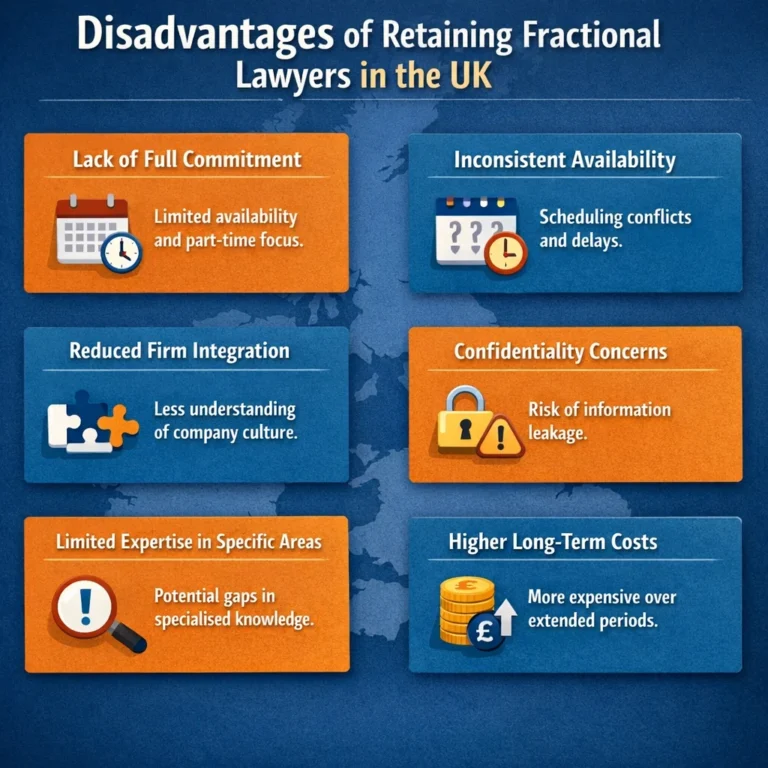
If fractional CFOs are the mature end of the market, fractional legal services are the fastest-growing. The logic is almost identical. Every growing business generates legal work—contracts, commercial negotiations, regulatory questions, employment issues, disputes, intellectual property, data protection—and very few can justify a full-time General Counsel. The result, historically, has been that SMEs either pay external law firm rates on every question (which quickly becomes unaffordable) or avoid getting advice at all (which quickly becomes risky).
A fractional lawyer or fractional General Counsel offers a third path. You get ongoing, senior legal support embedded in your business, at a cost that is a small fraction of either a full-time in-house lawyer or a traditional law firm retainer.
A fractional lawyer or fractional General Counsel offers a third path. You get ongoing, senior legal support embedded in your business, at a cost that is a small fraction of either a full-time in-house lawyer or a traditional law firm retainer.
What Fractional Legal Support Looks Like in Practice
A fractional legal engagement typically covers the full spectrum of work that a small or medium-sized business generates. On the transactional side, that means drafting and reviewing commercial contracts—customer agreements, supplier terms, partnership arrangements, licensing deals, confidentiality agreements, and the like. On the advisory side, it means being the person the leadership team calls when a legal question arises, whether that is a regulatory query, a contractual dispute, an employment issue, or a strategic question about structuring a new venture.
A fractional lawyer will also typically own the legal infrastructure of the business: template libraries, contract playbooks, standard terms of business, internal policies, and the systems that ensure legal risk is managed consistently rather than reinvented every time a new contract lands.
A fractional lawyer will also typically own the legal infrastructure of the business: template libraries, contract playbooks, standard terms of business, internal policies, and the systems that ensure legal risk is managed consistently rather than reinvented every time a new contract lands.
Why External Law Firms Are Not Always the Answer
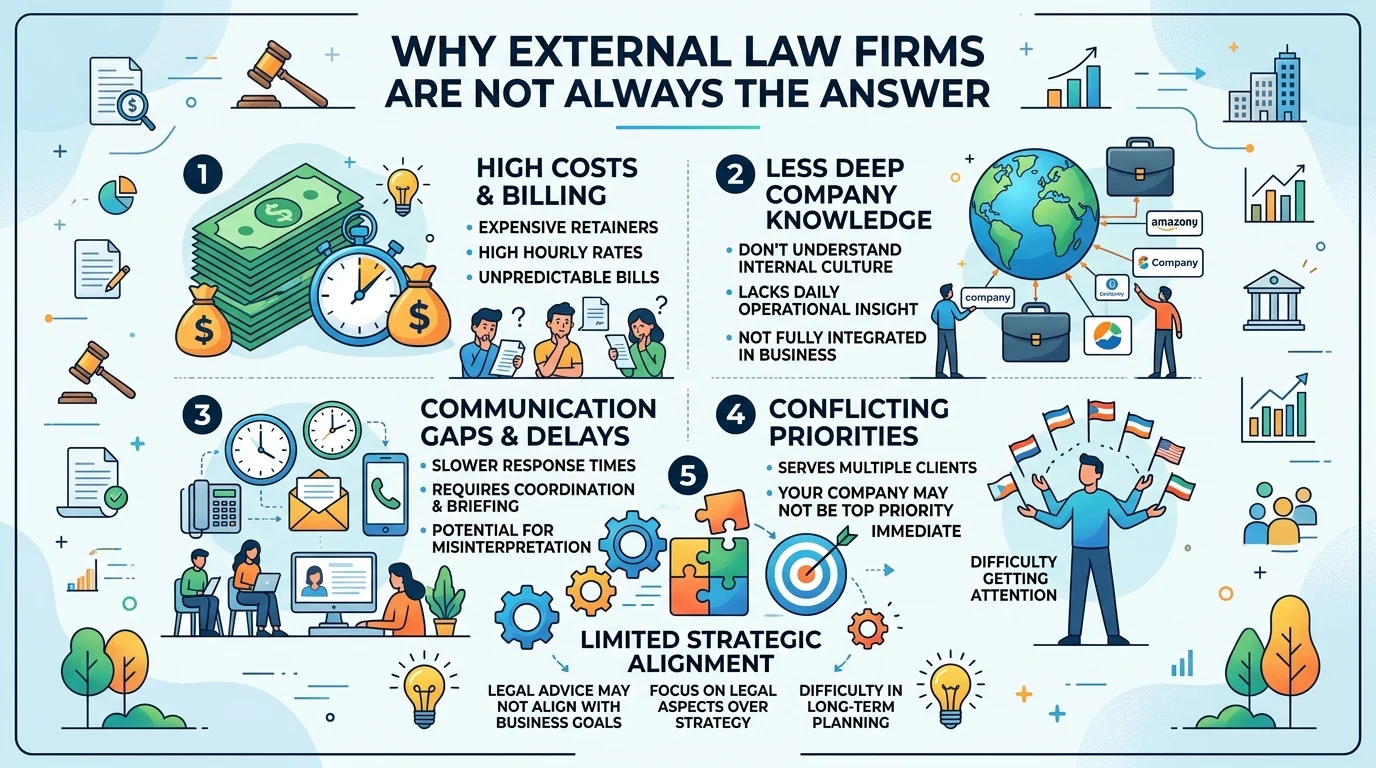
The traditional alternative to in-house legal support is an external law firm, and for specific, high-value, specialist matters that remains the right answer. But law firms are not built for the day-to-day flow of legal questions that a growing business generates. Firms bill by the hour, typically at rates that make small questions expensive and routine contract reviews disproportionately costly. They are also, by design, transactional—you engage them for a specific matter, they deliver, and the relationship pauses until the next instruction.
A fractional lawyer operates differently. They know your business, your contracts, your risk appetite, and your commercial priorities. They can answer a five-minute question in five minutes rather than opening a file and billing a unit. They can spot issues across transactions that a firm handling one matter at a time would never see. And they cost a defined, predictable monthly amount rather than an open-ended invoice at the end of each month.
A fractional lawyer operates differently. They know your business, your contracts, your risk appetite, and your commercial priorities. They can answer a five-minute question in five minutes rather than opening a file and billing a unit. They can spot issues across transactions that a firm handling one matter at a time would never see. And they cost a defined, predictable monthly amount rather than an open-ended invoice at the end of each month.
Parallels With the Fractional CFO Model
The structural parallels with fractional finance are striking. Just as a fractional CFO sits above your bookkeeper and external accountant, a fractional General Counsel sits above your external law firm and day-to-day business operations. The fractional lawyer handles the volume of everyday legal work in-house (at fractional cost), and instructs external counsel only for the specialist matters that genuinely require firm resources—a contested piece of litigation, a complex M&A transaction, a specialist regulatory filing.
The result is the same combination that fractional CFO services deliver on the finance side: senior expertise, embedded in the business, at a cost the business can actually afford.
The result is the same combination that fractional CFO services deliver on the finance side: senior expertise, embedded in the business, at a cost the business can actually afford.
When to Consider Fractional Legal Support
The triggers for bringing in a fractional lawyer are similar to those that drive businesses to hire a fractional CFO. Legal costs are rising unpredictably and external invoices are becoming a source of friction. Contracts are piling up and commercial decisions are being delayed while they sit in a queue. The business is entering a more regulated space—financial services, healthcare, data-heavy sectors—and needs someone who understands the regulatory environment on tap rather than on instruction. A fundraising round or commercial partnership is on the horizon and the founder needs a trusted legal partner to work alongside them, not just a firm at the end of a phone.
In all these situations, the value of a fractional lawyer is not just the cost saving, although that is real. It is the fact that someone with the experience of a senior in-house lawyer is genuinely inside the business, thinking about legal risk as part of the commercial picture rather than as an external input.
In all these situations, the value of a fractional lawyer is not just the cost saving, although that is real. It is the fact that someone with the experience of a senior in-house lawyer is genuinely inside the business, thinking about legal risk as part of the commercial picture rather than as an external input.
The Common Thread: Senior Expertise, Sized to Fit
Whether you are looking at a fractional CFO service, a fractional legal engagement, a fractional CTO, or any other flavour of the model, the underlying proposition is the same. The fractional approach lets you access the kind of senior expertise that was previously reserved for businesses large enough to employ a full C-suite. It does so on terms that match the realities of a small or medium-sized business: flexible, proportionate, and scalable.
For a generation of founders and business owners who have spent years navigating complex commercial, financial, and legal questions on their own—or paying premium external rates every time one arises—the fractional model is quietly but fundamentally changing what is possible. Senior talent is no longer the preserve of large corporates. It is available, on your terms, at a price that makes sense, for as long as you need it.
That, more than anything, is why the fractional model is here to stay.
For a generation of founders and business owners who have spent years navigating complex commercial, financial, and legal questions on their own—or paying premium external rates every time one arises—the fractional model is quietly but fundamentally changing what is possible. Senior talent is no longer the preserve of large corporates. It is available, on your terms, at a price that makes sense, for as long as you need it.
That, more than anything, is why the fractional model is here to stay.
Ready to explore fractional legal support?Book a free 30-minute legal health check to find out whether fractional legal support could work for your business. No obligation, no jargon, just an honest conversation about your needs.