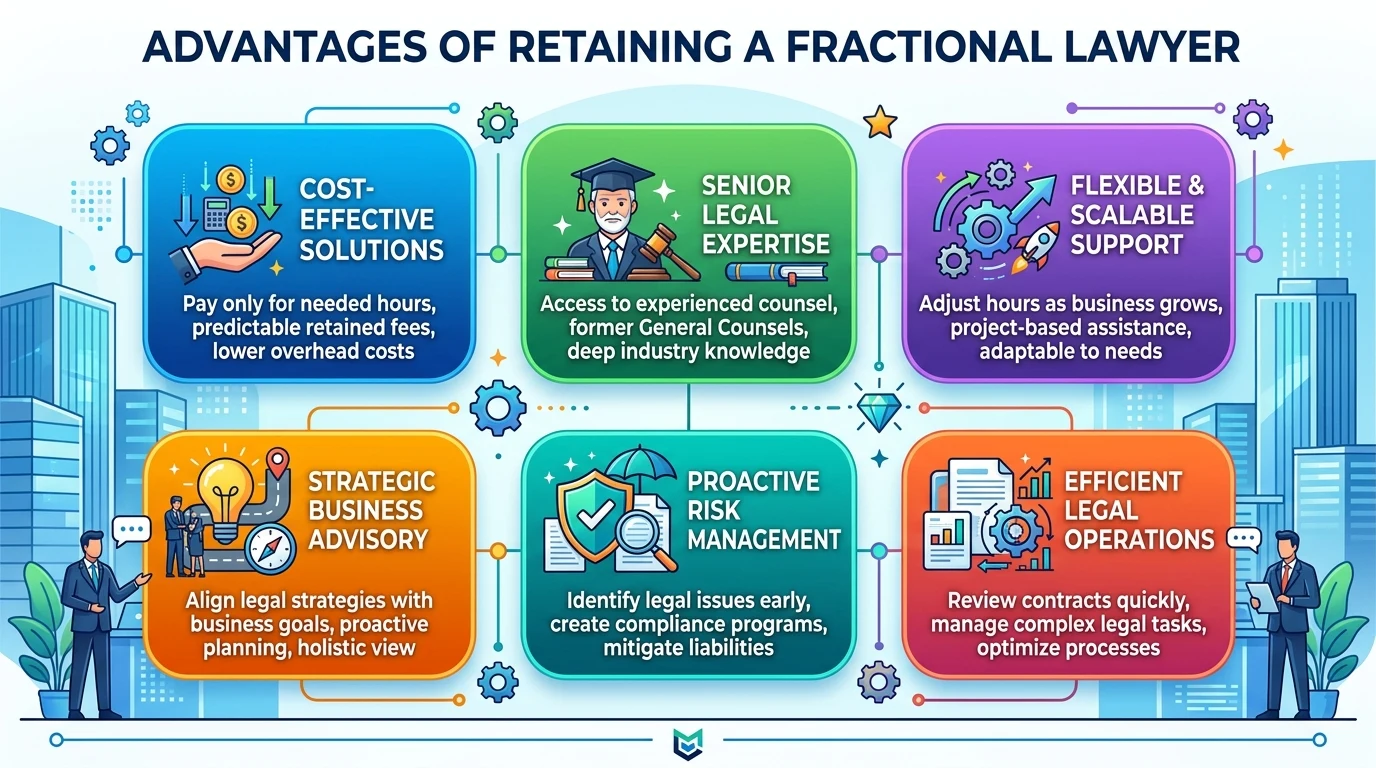

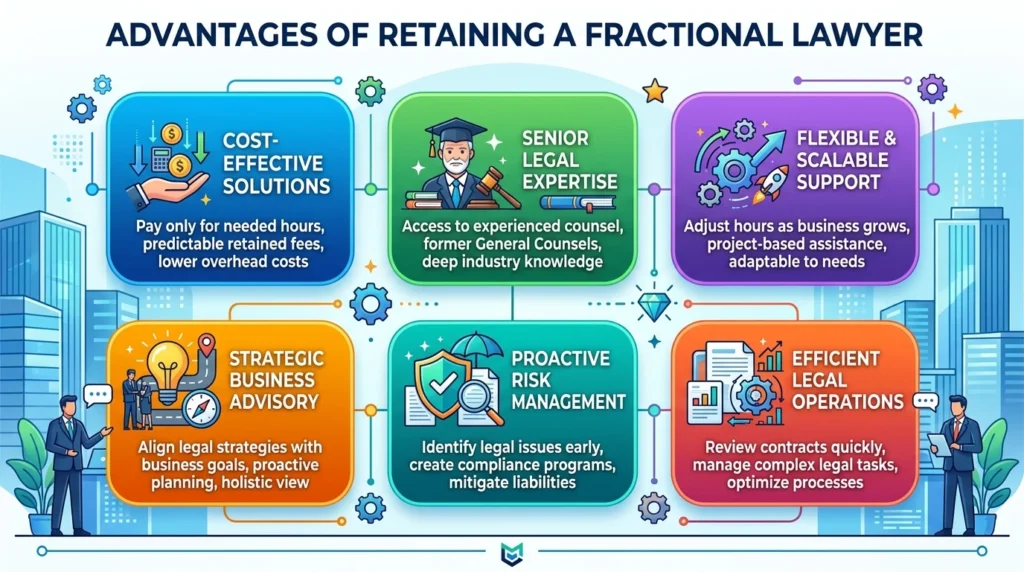
Advantages Of Retaining A Fractional Lawyer
For many UK businesses, the question is no longer whether they need legal input, but how they should access it. A growing company may need senior legal support, practical advice on contracts, help with regulatory risk, and a trusted commercial sounding board, yet still be far from ready to hire a full-time general counsel or build a complete in-house team.
That is where the fractional model stands out. Retaining a fractional lawyer gives a business access to experienced legal expertise on a part-time basis, often through a fixed monthly arrangement, and usually without the cost and without the overhead of a permanent hire. In the UK context, where businesses must navigate commercial contracts, employment obligations, data protection, intellectual property, investor expectations and sector-specific legal requirements, this model can offer a highly effective middle ground between relying solely on a traditional law firm and committing to a full-time hire.
Key Takeaways
| Flexible Legal Expertise | Cost-Effective Legal Support | Strategic Business Alignment |
|---|---|---|
| fractional lawyer provides senior legal advice on a part-time basis tailored to your business needs. | Access experienced legal counsel without the overhead of a full-time hire or traditional law firm fees. | Embedded counsel understands your business and growth goals, offering practical and strategic legal advice. |
| Enables businesses to handle legal work from time to time with continuity and trusted advisor relationships. | Hiring fractional lawyer reduces recruitment, employment, and operational costs while maintaining quality. | Hiring a fractional lawyer reduces recruitment, employment, and operational costs while maintaining quality. |
| Ideal for medium-sized UK businesses seeking internal legal support without committing to permanent hires. | The fractional model offers fixed monthly or flexible arrangements that match fluctuating legal demands. | The fractional model offers fixed monthly or flexible arrangements that match fluctuating legal demands. |
What Fractional General Counsel Means For In-House Legal Support
A fractional general counsel is an experienced legal professional who works with a business on a part-time or flexible basis, providing strategic and day to day legal support as needed. Unlike a solicitor in private practice who may only advise on isolated instructions, fractional legal counsel is typically more embedded in the business. They often attend leadership meetings, review internal processes, support the executive team and help shape decisions before problems arise.
In practice, a fractional gc may act as the company’s senior legal counsel, handling a broad range of legal matters including commercial contracts, risk management, governance, supplier terms, customer negotiations and escalation of disputes. For businesses that do not yet need a full-time general counsel function, this can be an efficient way to establish credible internal legal capability.
This is especially valuable in the UK, where directors are expected to manage risk responsibly and where compliance failures can carry serious commercial and reputational consequences. A good fractional lawyer in a fractional role does not simply react to issues. They provide legal insight that helps the business make better decisions from the outset.
In practice, a fractional gc may act as the company’s senior legal counsel, handling a broad range of legal matters including commercial contracts, risk management, governance, supplier terms, customer negotiations and escalation of disputes. For businesses that do not yet need a full-time general counsel function, this can be an efficient way to establish credible internal legal capability.
This is especially valuable in the UK, where directors are expected to manage risk responsibly and where compliance failures can carry serious commercial and reputational consequences. A good lawyer in a fractional role does not simply react to issues. They provide legal insight that helps the business make better decisions from the outset.
Why Hiring Fractional Legal Counsel Beats A Full-Time Hire For Many Business Needs
The strongest argument for hiring a fractional lawyer is flexibility. Many companies have genuine legal needs, but not enough ongoing legal work to justify a full-time hire. A scale up, owner managed business or expanding consultancy may need regular help with customer contracts, supplier disputes, terms and conditions, hiring issues and data sharing arrangements, yet only require that support for a set number of days each month.
In those circumstances, fractional legal support is often the more sensible answer. It enables businesses to access senior legal input at a fraction of the cost of recruiting a permanent in-house lawyer. It also avoids recruitment fees, employment costs, pension obligations, office overhead and the wider commitment that comes with a permanent hire.
For many leadership teams, the real attraction is not simply cost. It is the ability to secure experienced legal judgment that matches actual business needs. Instead of paying to hire a full-time solicitor before the company is ready, businesses can buy the right level of support at the right time. That makes the fractional lawyer model particularly attractive for ambitious companies that want strong legal oversight while remaining commercially lean.
Fractional GC As A Trusted Advisor For Legal Work From Time To Time
One of the most overlooked benefits of fractional support is continuity. Many businesses use external solicitors only when a problem becomes urgent. They instruct a law firm for a dispute, a financing round or a complex contract, then return to operating without any ongoing legal resource. That approach can leave gaps between projects and create unnecessary risk.
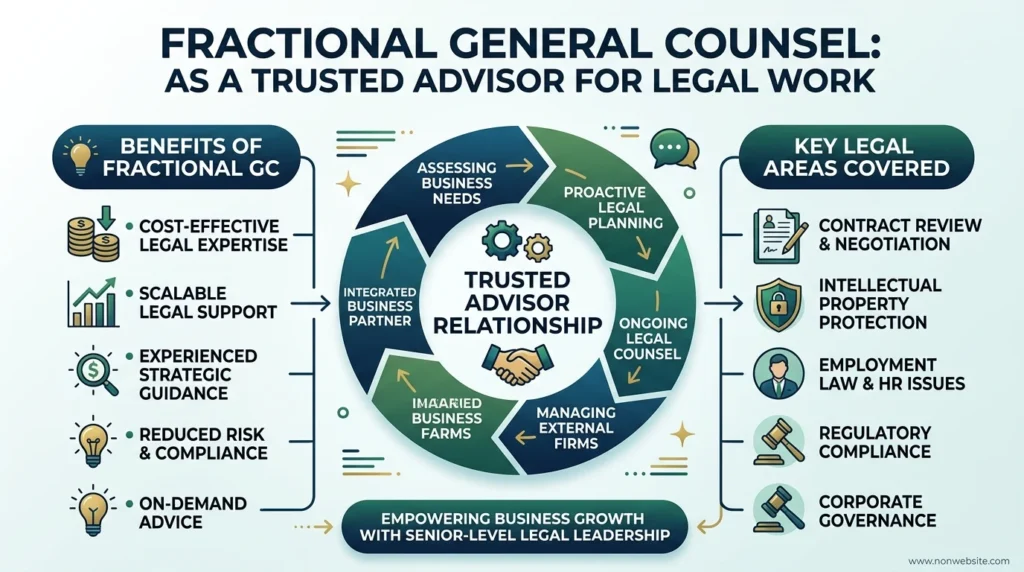
A fractional lawyer changes that dynamic. Because the same lawyer works with the company on an ongoing part-time basis, they become a genuine trusted advisor who understands your business, your leadership style, your appetite for risk and your growth goals. That means better decisions, faster turnarounds and advice that is rooted in commercial reality rather than abstract legal theory.
This is particularly useful where companies need legal work from time to time, rather than daily support. A business may not need constant legal involvement, but it may regularly face new agreements, customer escalations, procurement issues, branding questions or board level concerns. In those cases, counsel engagements offer continuity and judgment without unnecessary spend.
Benefits Of Fractional General Counsel For In-House Teams And Internal Legal Operations
The benefits of fractional lawyerare not limited to businesses with no legal function at all. Some companies already have an internal team or junior legal staff, but need additional senior legal oversight. In that setting, a fractional gc can strengthen legal operations, support capability building and act as a bridge between management and the wider in-house team.
For example, a business may have capable commercial managers handling routine terms, but need a more experienced legal counsel to review high value negotiations, set playbooks, improve approval processes and reduce bottlenecks. A fractional lawyer can help the internal team become more efficient, while also taking on more complex or strategic legal issues.
This model works well for medium-sized businesses that are not yet ready for a full-time general counsel, but have outgrown purely reactive support from a traditional law firm. It also suits private equity backed businesses, founder led companies and UK subsidiaries of overseas groups that want a local, commercially minded in-house presence without building a large legal department too early.
Fractional Legal Counsel For Commercial Contracts, Intellectual Property And Other Legal Matters
A common misconception is that a fractional arrangement only covers general governance. In reality, fractional lawyer services often span a wide range of legal matters. A skilled fractional lawyer may handle or supervise commercial contracts, software and SaaS agreements, supply terms, reseller arrangements, consultancy agreements, confidentiality provisions, procurement documents and strategic partnerships.
They may also advise on intellectual property, brand protection, licensing structures, technology development agreements and the ownership of work product created by contractors or employees. In a UK business environment where innovation and brand value can be central to growth, having consistent oversight of these issues is highly valuable.
Alongside transactional support, fractional lawyer services can include policy drafting, risk reviews, governance support, dispute prevention, support on employment related legal questions and help in managing external specialists. A strong fractional legal adviser knows when to handle matters directly and when to brief a niche law firm on tax, litigation, property or regulatory questions. That combination often delivers a more efficient and cost conscious legal service overall.
Fractional Legal Service Versus A Traditional Law Firm
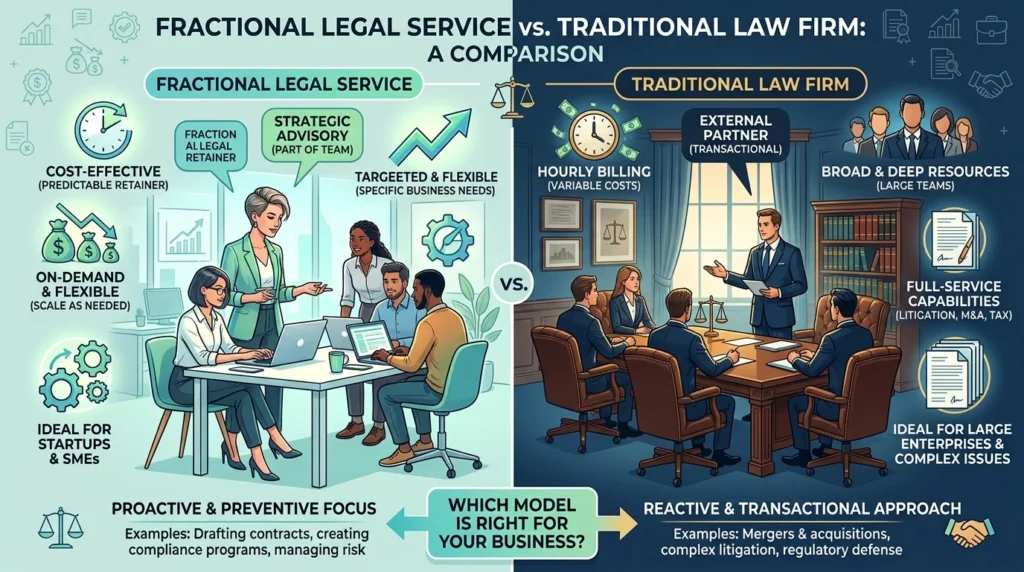
There is still an important role for the external law firm, especially for specialist or contentious work. However, many businesses discover that private practice alone does not fully meet their day to day commercial needs. External advisers are often excellent at answering defined questions, but less well placed to act as a continuous internal sounding board.
A fractional lawyer fills that gap. Because the counsel provides ongoing support, they can spot patterns, improve internal processes and prevent problems before they reach the stage where expensive external advice is needed. They can also translate legal risk into commercial terms for founders, boards and operational leaders.
That is one reason why the fractional model can reduce overall legal spend. It does not necessarily replace external solicitors, but it helps businesses use them more intelligently. Routine legal work can be handled in house through the fractional arrangement, while specialist matters are escalated only where appropriate. The result is often better management of legal budgets and stronger control over external advisers.
When Counsel Engagements Make Sense Instead Of A Permanent Hire
Not every company should immediately recruit an in-house lawyer. The right timing depends on volume, complexity and trajectory. Counsel engagements are often ideal where a business is growing quickly, entering new contracts, hiring more people or preparing for investment, but still lacks enough steady legal work to justify a full-time hire.
This applies to many UK scale ups and medium-sized businesses. They may need robust legal support, but only for one or two days a week, or perhaps a few days each month. In these circumstances, fractional lawyer offers a practical route to senior coverage without locking the business into a permanent hire too soon.
It is also useful during transition periods. A company may need temporary support while recruiting, while an existing gc is on leave, or while deciding whether to build a permanent in-house function. In each of these cases, a fractional gc offers continuity, speed and flexibility.
How A Fractional Lawyer Understands Your Business And Provides Practical Advice
The best fractional lawyer does more than answer legal questions. They become part of the commercial conversation. They attend meetings, learn the revenue model, understand customer relationships and identify where legal friction is slowing growth. Because they are closely aligned with the business, they can offer practical advice that reflects commercial priorities as well as risk.
That is a key difference between standard external advice and embedded in-house style support. A good lawyer in this role understands your business and can tailor their input accordingly. Their legal advice is more likely to be actionable, proportionate and timed to support decision making rather than delay it.
For leadership teams, this can be transformative. It means having an experienced legal professional who helps shape outcomes rather than simply comment after the fact. It also means the business can access strategic legal thinking on matters such as governance, sales risk, contracting policy and expansion plans, all on a part-time basis.
Benefits Of Fractional General Counsel For Business Needs And Growth Goals
The long term value of this approach lies in alignment. A fractional general counsel supports the company in a way that reflects current business needs, budget and stage of growth. As those needs evolve, the arrangement can scale up or down. That makes the model particularly useful for businesses pursuing ambitious growth goals while managing cash carefully.
It also enables businesses to professionalise their legal function earlier than they otherwise might. Instead of waiting until legal risk becomes painful, they can put in place a senior adviser who helps create better habits, stronger documentation and more effective governance from the beginning.
For some companies, the fractional lawyer arrangement is a stepping stone before they eventually hire a full-time GC. For others, it remains the right long term solution because their legal needs are significant but not constant. Either way, the business gains access to experienced legal support, stronger internal legal processes and better commercial protection without the overhead of a full permanent team.
Conclusion
In the UK market, retaining a fractional lawyer is increasingly recognised as a smart and commercially balanced option. It offers access to legal expertise, continuity, strategic insight and responsive legal support, all without the cost of an early full-time hire. Whether a company needs an embedded in-house lawyer, support for commercial contracts, guidance on intellectual property, or a trusted advisor who can manage evolving legal issues, the model has clear advantages.
For businesses that want senior legal capability, but only on a part-time or flexible basis, fractional lawyer services can deliver exactly what is needed. They combine the judgment of a seasoned gc with the agility of a modern outsourced model, helping companies handle legal requirements, support growth and make better decisions with confidence.
You can find additional information on Fractional Lawyers in our article What Are Fractional Legal Services? Fractional General Counsel
Ready to explore fractional legal support?Book a free 15 minute legal health check to find out whether fractional legal support could work for your business. No obligation, no jargon, just an honest conversation about your needs.